
The tech behind top2000feitjes.nl
In just under two weeks, a humble Top 2000 list grew into the Top 2000 site: live radio, studio footage from NPO Radio 2, a search engine that forgives typos, a Top 2000 Forum, a Top 2000 pop quiz and a server that keeps an eye on itself. This is the complete story: what I built, and above all how. Because behind it all stand three pillars: fast, secure and private.
I thought I was done. I thought so with I just wanted to take a look too (opens in a new tab), and then a lot more sprouted from my brain. Apparently, “just taking a look” is, for me, a verb without an end date. With top2000feitjes.nl it went exactly the same way: first a little list, then a search function, then live radio, then studio footage, then a quiz. Everything is listed below. Grab a coffee, and maybe lunch.
First the list: everything added to top2000feitjes.nl in two weeks
On 2 November 2026, top2000feitjes.nl (opens in a new tab) went live, my site about the Top 2000 of NPO Radio 2. Since then, something was added almost every day. Below, everything in a logical order: from the foundation to the decoration. Each item says briefly why it exists and what it does for the Top 2000 fan.
1. The foundation: the whole Top 2000 in one database
- All 27 editions of the Top 2000 in one database. From 1999 up to and including 2025: 27 Top 2000 lists of 2000 songs each, 54,000 entries in total, of almost 5000 different songs. All top 100s were compared position by position with other sources; no real deviations were found, only spelling variants.
- Static pages. The site is built with Jekyll: ready-made pages, no database that has to work on every visit. That is the basis of the speed.
- Dutch and English. The whole site is also in English (/en/), with a flag button.
- A page of its own for every Top 2000 song, artist, year and presenter, with explanation, facts and questions, so Google also lands you on exactly the right card. Searching for “Top 2000 1999”, “Top 2000 2025” or “Top 2000 presenters”? Works.
2. Live listening and watching
- Live radio from NPO Radio 2 and the Top 2000, which keeps playing while you click through the site, because the page doesn’t reload.
- The live block: for the song that is playing now you immediately see whether and where it appeared in the Top 2000, with a link to the artist and the song. My own collector checks every 30 seconds what is playing; within about 40 seconds of the switch at NPO, the song is on your screen.
- Live studio footage (Top 2000 Café) in a window of its own, in three sizes, with a volume slider. You drag it wherever you like.
- Watch live: one click and the video sits on the left with the radio floating beside it on the right, neatly aligned. That is now the default on computer and iPad.
- Floating windows that stay where you put them, with size and position remembered.
- A news ticker over the live picture, with headlines from 14 sources in the Netherlands and Flanders (NOS, NU.nl, RTL Nieuws and more), with source attribution, adjustable per category or switched off entirely.
3. Searching and finding
- Smart search with the magnifying glass or the
/key (also Ctrl/⌘+K): by artist, song, presenter, fact or page, and typos are fine. - The Basement League: more than 4 million songs by more than 50,000 artists that never made the Top 2000, and therefore are Never charted, shown under the search results (off by default, one tick to add them).
- The complete Top 2000 per year, from position 1 to 2000, with a search window of its own and the “Search all years” tick.
- Your last search term is remembered, as is your choice for “Also Basement League”.
4. Looking up what was played
- Previously played: the last 30 songs (Top 2000 or a regular Radio 2 day), right under the live block.
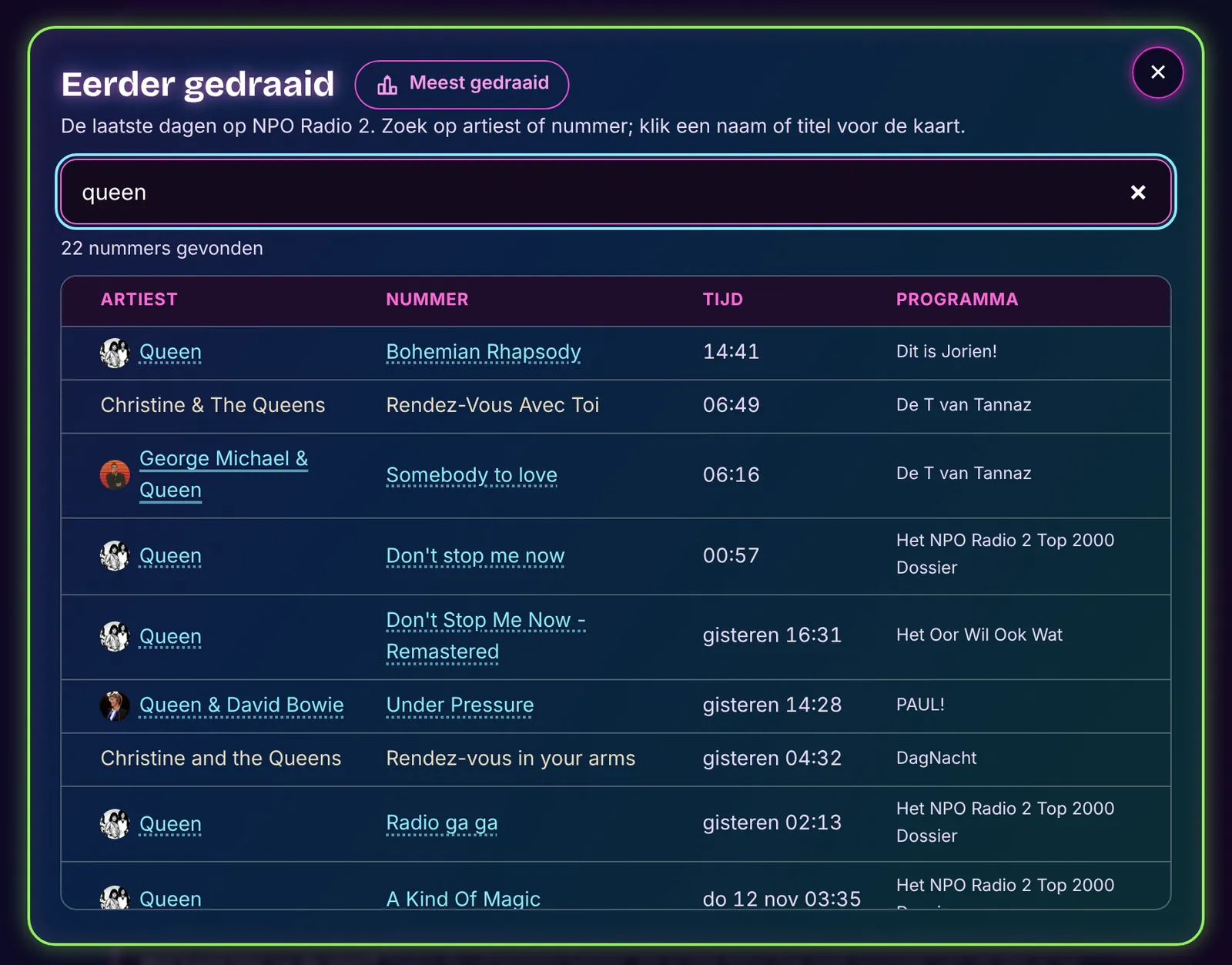
- More?: a searchable listening history of the last 7 days, with time and programme. Search by artist or song and click through to the card.
- Most played: the top 10 songs and top 5 artists of the past 7 days.
- Last played on the song card: when NPO Radio 2 last played this song, even for songs from weeks ago (via the NPO archive of the last 60 days).
- Explanation for gaps: if NPO stops supplying song info for a quarter of an hour or more (as in the Muzieknacht or some programmes), the list says so, instead of leaving you to guess.
5. Stories, news and depth
- Featured artists: from 33 to 184 Top 2000 artists with short stories, with sources and photos (at most seven per artist). Who gets added is up to me, based on my own taste.
- In the spotlight: every day an artist at the top right of the screen, with a “Today” sash. Click and the artist card opens.
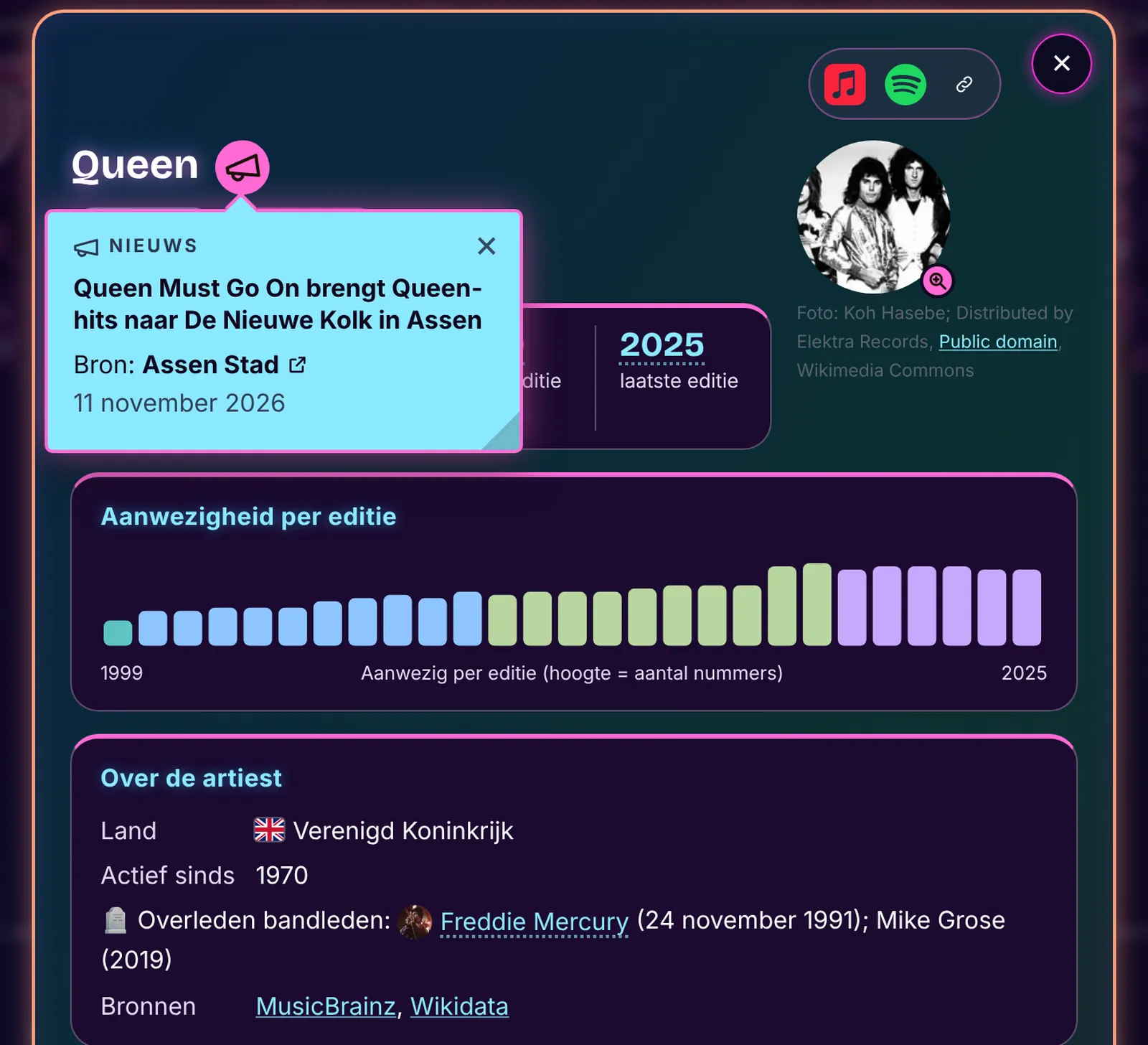
- Artist news: if there is recent news about an artist or presenter, a megaphone appears next to the name. Click and you see the latest item on a sticky note, with source and date.
- Yearly overviews of all Top 2000 editions with news facts from that year, and the pages On this day, All Star, Late bloomers and The Top 2000 in 10 numbers.
- In pictures: Rat Race (the top 10 artists as a race per edition), World map, Networking and The Whole Record.
- Radio history and Radio technology: from the inventors to AM, FM and DAB+.
- Photos only from Wikimedia Commons, with maker and licence.
6. Taking part
- The Top 2000 pop quiz, hotshot!: ten multiple-choice questions about the Top 2000 per round, three levels (Singalong, Record Buff, Oracle), the faster the more points, a new edition every week and a Hall of Hotshots.
- The Top 2000 Forum: chatting about the Top 2000, with replies to replies, thumbs-up and hearts, and names that can link to their card on the site.
7. Looks and entertainment
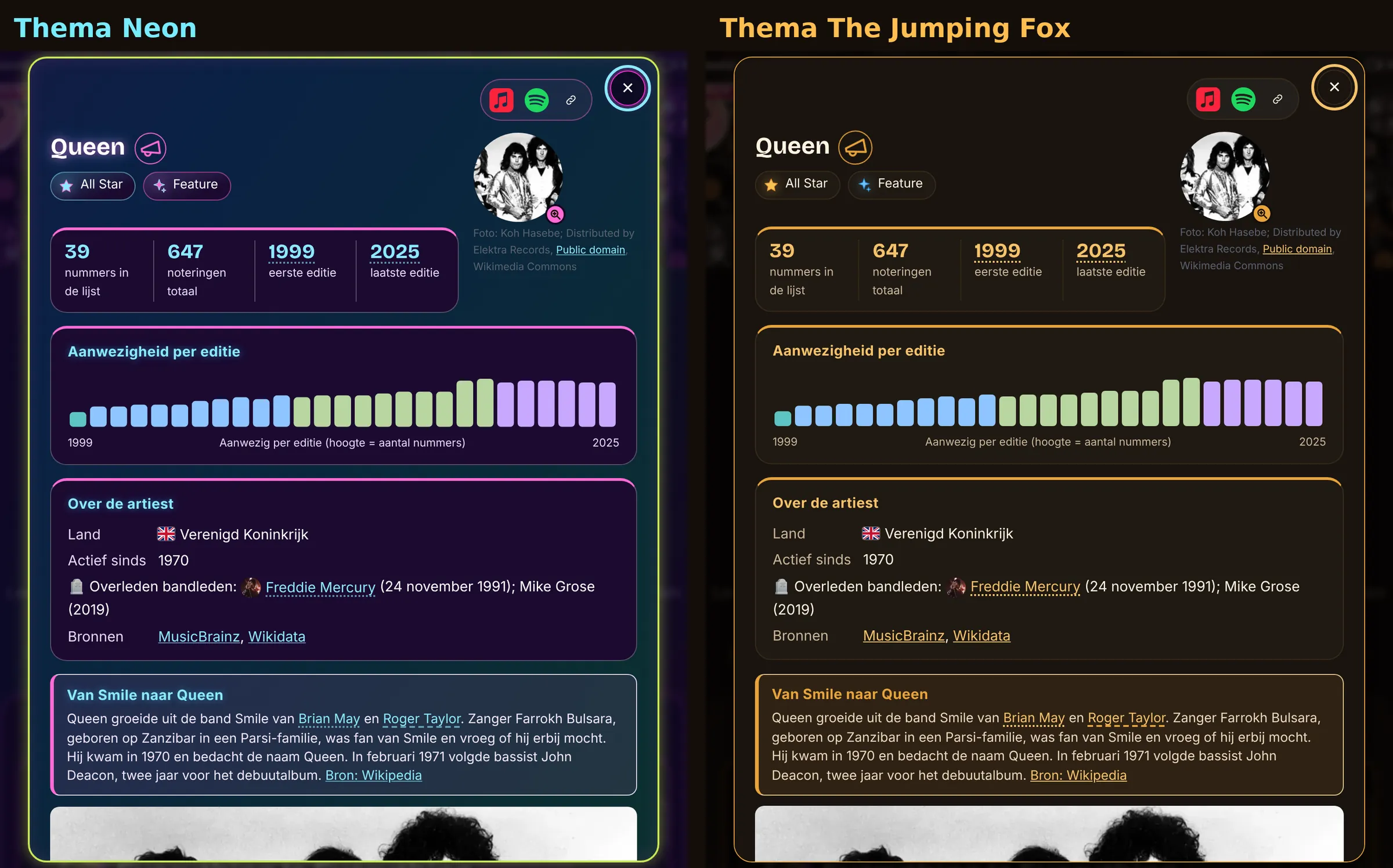
- Theme Neon or Jumping Fox: purple, pink and cyan, or the warm golden-brown style of my own brand.
- Party mode: confetti, lasers and balloons for a new top 10 or number 1.
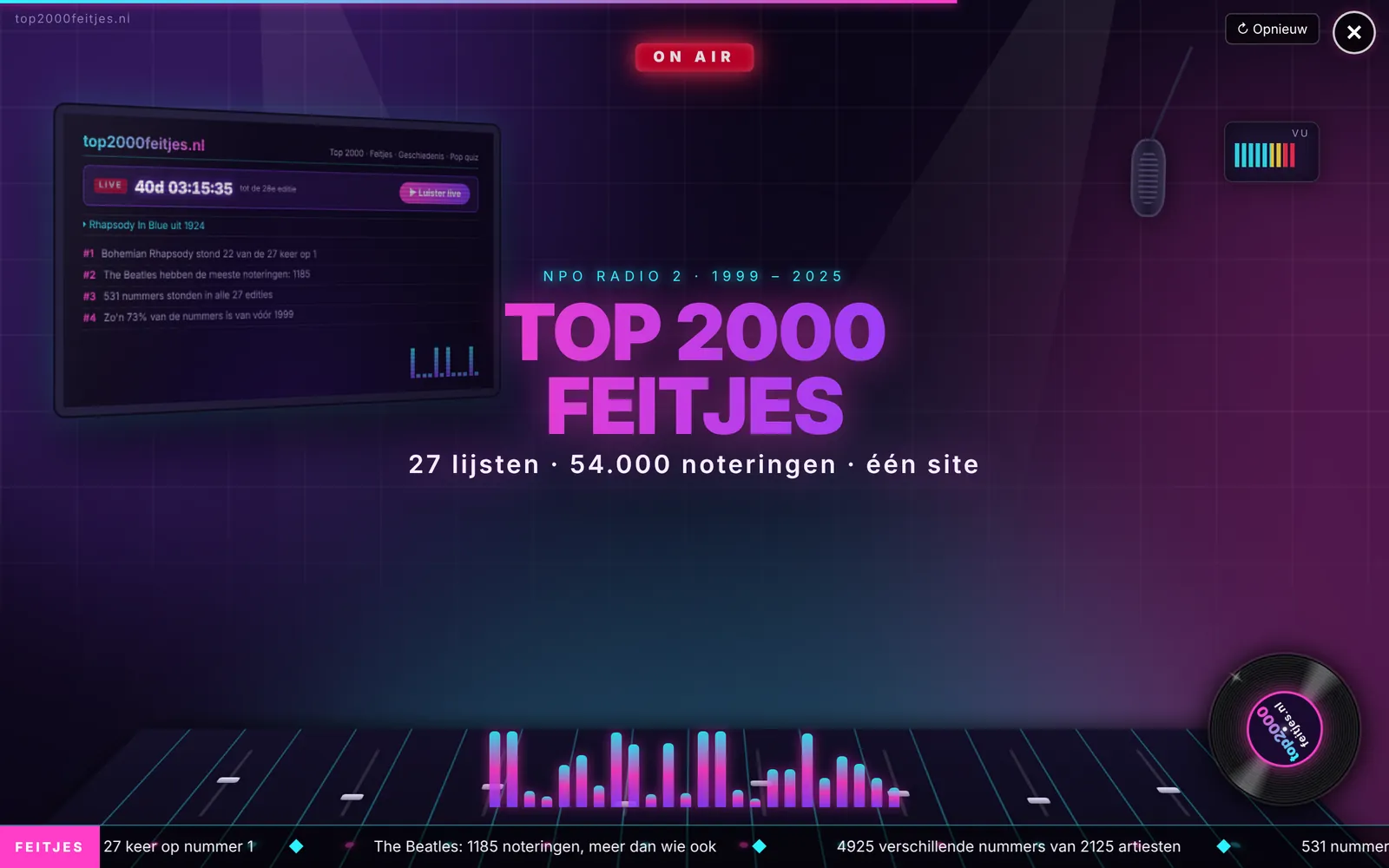
- Showtime!: a full-screen show (computer and iPad) with an ON AIR light, for when you want to show what is possible. It even remembers which scene you saw last.
- The light newspaper (ticker) with 124 remarkable facts, All Star badges, Popcorn & Record and What are they singing?!
- Apple Music and Spotify on every song card, and Download lists as an Excel file in the colours of your theme.
8. Remember everything, track nothing
Settings, window positions, muted sound, theme, ticker categories and your last search term are kept in your own browser. That is deliberate: I don’t need to know anything about you to remember it for you. More on that later.
The three pillars of my Top 2000 site: fast, secure, private
With everything I build, this Top 2000 site included, the same applies: it must be fast, secure and private. If a nice feature harms one of those three, it gets changed or I leave it out. That is not a principle on paper: it steers every choice, from the database to the spot where a button sits.
Pillar 1: speed
PageSpeed 100 for Performance, Accessibility, Best practices and SEO is my fixed condition. For every site I deliver. That is hard for a site with live radio, video windows, a ticker, a light newspaper and a quiz; which is exactly why it is a good test. For top2000feitjes.nl, Google PageSpeed reads 100/100/100: Performance, Accessibility, Best practices and SEO all at 100. Even after all the live features, and it has to stay that way. How I keep my finger on the pulse, I wrote down earlier in My finger on the pulse (opens in a new tab). Anyone who thinks reaching 100 is the hard part has never tried to still be standing on it after two weeks of building features.
Where the speed comes from:
- Static instead of dynamic. Pages are built in advance. The visitor simply gets a file, not a calculation.
- SQLite, queried in advance. The results from the database are put into fixed pages. The visitor never notices the database (see the SQLite section below).
- Cloudflare in front. Since 11 November the site has been delivered via Cloudflare, a network of servers all over the world. Pages, images and scripts therefore come from nearby, and the site is better protected against busy periods and abuse.
- Small files. The logo is 28 KB, the banner comes in four sizes in WebP, the scripts are minified and everything that doesn’t change gets a cache time of a year.
- Animations that pause when you can’t see them. The spinning LP, the ticker and the live dot stop as soon as they are out of view or your tab is in the background. That saved 36 percent of main-thread work and took the page from about 315 to about 8 recalculations in six seconds. Nobody sees the difference, your phone’s battery all the more.
- Normal tap targets. Buttons are big enough for a finger. That counts for PageSpeed too.
Pillar 2: security
Security is not a one-off action. It is a rhythm of checks. This is what runs.
With every change: the deploy routine
A change never goes live “quickly, just this once”. Every time I follow the same steps, in this order:
- Backup first. Before any file is overwritten, the server makes a backup of exactly the files that are about to change. Rolling back is then one command.
- Hash check on every transfer. A package travels from my Mac to the server. On both sides the SHA-256 fingerprint is calculated. If they are not identical, nothing gets unpacked.
- Check against the old version. Before overwriting, I compare the files on the server with the version the change was built on. If the server holds something newer, the server wins.
- Permissions and owner. Files get 644, folders 755, owner the site’s account. That sounds boring, until it goes wrong. With one of the packages, the site briefly showed “Forbidden”, because folder settings from my build environment had been laid over the web root. I fixed it within minutes, compared it with the backup (0 differences) and made a fixed rule of it: packages contain only files, never folders, and after unpacking the folders are checked too.
- Tests. All pages 200, the new content is really in there, the syntax of all PHP files is checked.
- Clear the Cloudflare cache and only then look at the real, live site, on computer and on phone.
In the background: checks that run by themselves
- Weekly server and security check: uptime, load, disk space and whether all services are running.
- Log check and site audit: every week, the logs are scanned for error messages and suspicious traces, and for missing or incorrectly configured files and permissions.
- Link check: the sitemap (more than 8000 addresses in two languages) is walked in full for status codes, redirects and noindex errors; and another check shows whether references between my own sites still work.
- Load log and mail alarm: every minute the server’s load is recorded. If two measurements in a row run too high, I get an email.
- The warden: a script that checks whether every scheduled task (the weekly mails, the checks) has actually run, and sounds the alarm if one is missing.
- Daily and weekly backups, of which the database backup is also checked for integrity.
- fail2ban blocks anyone who repeatedly tries to break in. For mail attacks the rules are strict: three failed attempts and you’re out for a day.
- Ports closed. Admin ports are only reachable from my own addresses and via a private network (Tailscale). What doesn’t need to be public, isn’t.
- A vulnerability in PHP that did the rounds at the end of October, I fixed on the same day with a patched build, followed by a check for backdoors: 242 PHP files compared with my sources via hashes, logs searched, users and cron jobs reviewed. No sign whatsoever of a break-in. I expressly call that a check for traces, not proof, and that is why I repeat it.
- Security pages: security.txt, HSTS and modern TLS are in order, and I follow up on the Cloudflare security scan.
More about how I build my sites securely can be found in the popup Behind the scenes, behind the shield with SECURELY BUILT.
Pillar 3: privacy
The starting point: what I don’t need, I don’t keep. The whole story about building securely and privately can also be found in the popup Behind the scenes, the shield. It’s written in plain English, without the small print.
- No cookies, no ads, no third-party trackers. The visitor count is anonymous, works without cookies and without IP addresses, and only counts how often pages and features are used.
- Everything you set stays with you. Theme, window positions, search term: in your own browser, not on my server.
- Taking part is voluntary and minimal. The quiz works without an account. If you want to be on the leaderboard, you log in with your email address and a personal six-digit code. You only appear in the Hall of Hotshots under a nickname you choose yourself, and you only get emails about a new quiz round if you tick that box yourself, with one-click unsubscribe. The code itself is not stored: it is derived per user with a secret key on the server.
- The forum on top2000feitjes.nl asks for an email address only to prove the comment is yours. You can always delete your own comments and have your data erased. IP addresses are readable to me for 30 days at most (so I can block abuse), after which only a code that can’t be traced back remains. No web addresses in comments, no swearwords, and anyone who misbehaves is blocked. Long comments (from 400 characters) have a TLDR button with a short summary, made by a computer (AI) and marked as such. For that, the text of that long comment is sent to Anthropic; it says so in the forum’s privacy rules. The summary is always shown as plain text and goes through the same filters as the comment itself.
- Clear sources. Photos come only from Wikimedia Commons with maker and licence, the news shows only the headline with source and link, and the lists come from Erwin Groenhof’s database, checked against other sources.
- The privacy statement is on the site and was updated when Cloudflare came along.
SQLite, explained once more
I have written about it before, but it belongs in this story. SQLite is a database in one ordinary file, without a separate database server. The program that needs the data opens the file and asks it questions, in the language SQL. That makes it light, fast, reliable and easy to back up: you just copy the file.
The entire Top 2000 since 1999, all 27 editions, fits in about 5 megabytes. The Basement League, with more than 4 million songs, lives in a file of about 460 megabytes, and searching it takes a fraction of a second. The results are put into fixed pages in advance, so the visitor never notices the database and the site stays fast. SQLite is free software and one of the most widely used databases in the world: your phone and your browser quietly use it for their own data. It is also exactly why a backup is so simple: one file, one hash check, done.
More explanation can be found in the popup SQLite, a database in one file, where I explained it earlier for my own sites. Yes, a whole database in one file. You could even email it, although I advise against it.
Smart searching in the Top 2000, everywhere
On top2000feitjes.nl the magnifying glass sits at the top right and at the bottom of every page. Press / and the search window opens without a mouse. You find:
- Top 2000 artists, songs, presenters, facts and pages all at once;
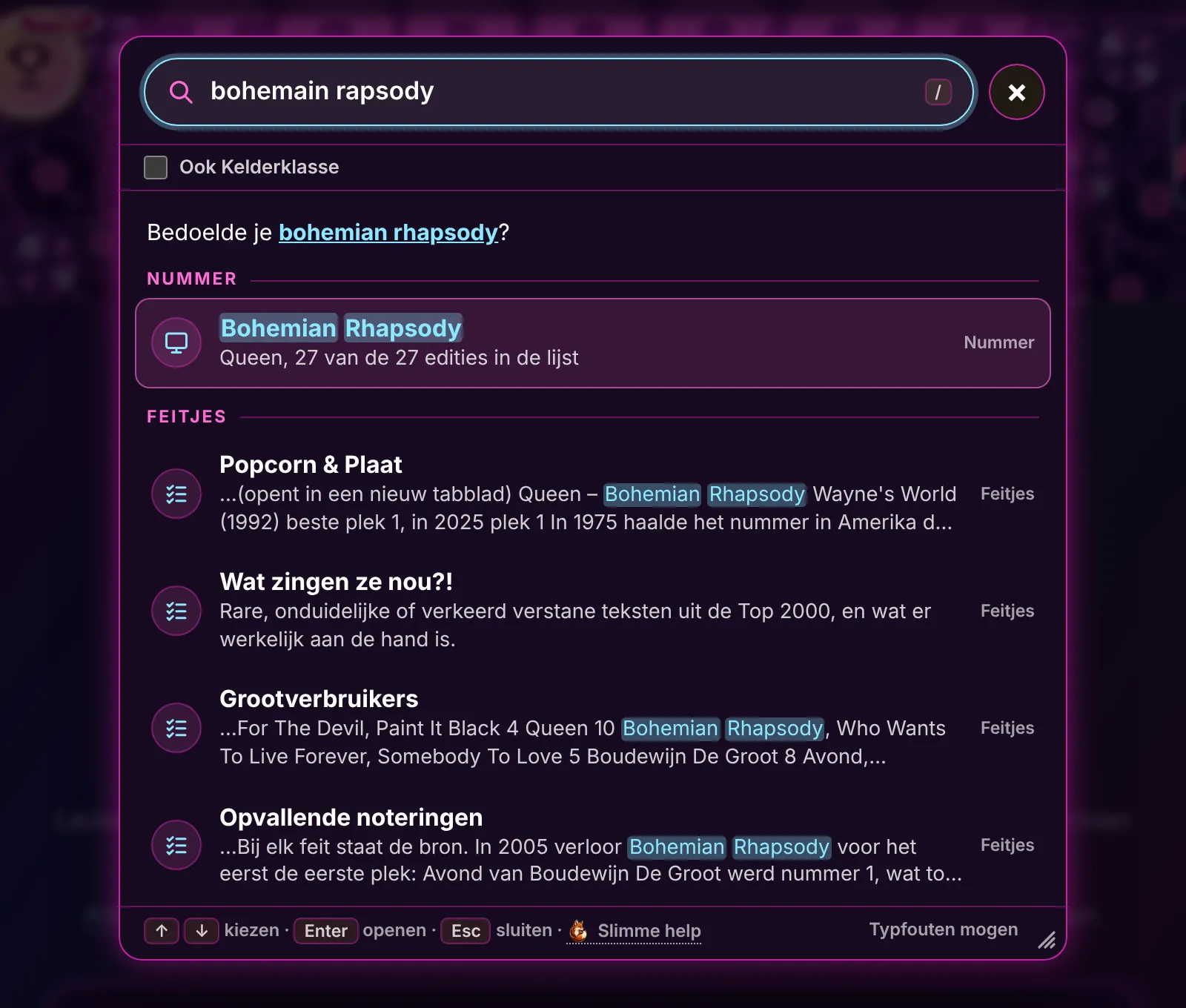
- with typos: “bohemain rapsody” simply finds Bohemian Rhapsody, and so does an English artist whose name you half-remembered wrong;
- under the Top 2000 results also the Basement League, if you feel like it: it is off by default and you add it with one tick (“Also Basement League”);
- within a year’s list, across all years at once, within the listening history (“More?”), within the forum comments and within a Basement League artist.
And because I don’t want you to start over every time: your last search term is kept. As are the position and size of your windows, the theme and your ticker choices. Very convenient, and private too.
What gets corrected in the background
A Top 2000 site like top2000feitjes.nl with live data that comes from another party has to withstand a bump or two. A few things you never see, but which make sure it is right:
Duplicate songs from NPO (shame on you, NPO!). The “More?” list got duplicate lines. Two causes. One: the same play arrives via two sources, the stream title (“The reflex”) and the NPO data (“The Reflex (Album version)”), within the same minute but with a different title suffix; that happened 51 times. Two: some songs are reported several times a day in the NPO feed, like Queen with Don’t Stop Me Now, which appeared 13 times in one day. My solution: same artist, same base title (without “(Album version)”, “[Live]”, “Remastered 2011” and the like), and less than 3 hours after the previous play, is one row. For a real repeat the latest start time counts, for the same play the first. The script tidies up after itself on every run and is idempotent: a second run changes nothing. The first run removed 62 duplicates, from 1965 to 1903 lines. As a side effect, “Most played” no longer counts a promo thirteen times.
Outdated data. NPO delivers via several servers, and one sometimes runs a few minutes behind. So I built a guard that never overwrites a newer song with an older one.
When the live playlist stops working. If NPO reports no songs for more than a quarter of an hour, the list says so: “since 22:53: no song info from NPO”. For programmes where NPO only passes on part of the songs, such as the Muziekcafé, there is also a neat notice. That way a gap is explained, not wrong. If the status file drops out because of a strange character in a title (yes, that happened), it repairs itself at the next song, and afterwards I removed the cause.
When the radio connection drops. The player tries up to ten times, with longer and longer pauses (2, 4, 8, 15, 30 seconds and then doubling), and reports in red “The connection dropped. Reconnecting... (attempt 3 of 10)”.
When the video picture stops. The page first tries once more by itself. If that fails, it says “No picture for a moment” with the button “Reload picture”, which fetches a fresh address for the footage without the radio stopping. If that doesn’t help either, you get the choice “Try again” or “Refresh page”. Behind the scenes, a script renews the stream’s address automatically before it expires.
News that is right. Artist news comes twice a day from Google News and stays for 60 days. A band called “Falco” or “Snelle” produces mountains of nonsense at first: football reports, a footballer, a watch. So the filter is strict: the name must appear as a whole word in the headline, for short or common names with the same capitals and with a music word, and sports words exclude the item. 26 of the 369 items dropped out right away. Rather less news than wrong news.
It stays honest. Basement League songs that are already in the Top 2000 (for example “Love & Pride” versus “Love And Pride”) are hidden for the same artist: 246 of them in the first round.
Showtime! and the party effects of the Top 2000
A bit of silliness belongs with the Top 2000. For a new song in the top 10 the party breaks loose with lasers and balloons; for number 1 the full show follows with confetti. Want it without? Then simply switch Party mode off in Settings, and anyone who prefers less motion gets that too. And then there is Showtime! on top2000feitjes.nl: a full-screen show with a red ON AIR light, on computer and iPad only. It is there to show what is possible, and it also works as a taster of what I could build for your site. And yes, this too is fast and costs no extra loading time, because it is only loaded when you ask for it.
What this can mean for you
All this is not meant to show off technology, although I admit: a little. (Okay, a lot.) It shows what is possible when you build a site with your own data, live information, search functions and serious attention to speed, security and privacy. Are you a Top 2000 fan too, or do you have an idea for a website with lots of data, live information or simply a great many facts? Or custom software that does what an off-the-shelf package can’t? Have a look around the Top 2000 site (opens in a new tab), and tell me what you want.
#Top2000 #Top2000Feitjes #Top2000Quiz #Top2000Forum #Top2000Popquiz #NPORadio2 #Radio2 #WebDevelopment #Portfolio #PageSpeed #Privacy #Security #Cloudflare #Jekyll #SQLite #Showtime #BlazingFastWebsites #CustomSoftware #TheJumpingFox
Regards,Pim